The True Cost of Facade Defect Rectification
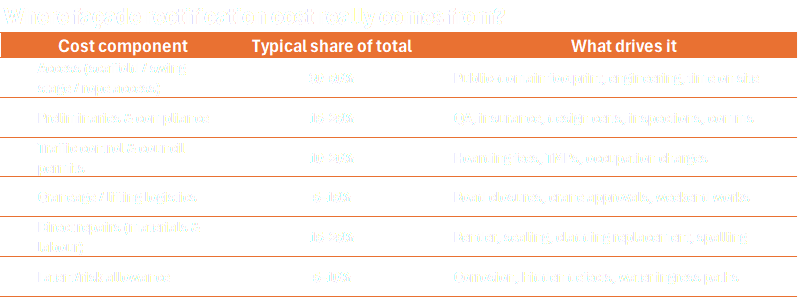
Façade defect rectification is seldom dominated by the direct materials required to fix the issue. Instead, the largest cost loads arise from access, preliminaries, public‑domain constraints and compliance, making rectification work disproportionately expensive compared to the underlying defect.
Local councils require approvals for temporary structures, including hoardings, scaffolding and façade‑retention systems whenever works encroach on roads or footpaths. These approvals involve technical design requirements, bonds, fees and recurring monthly charges. These obligations sit alongside mandatory public‑liability insurance and traffic‑management plans which further raise cost.
In the dispute context, Australian courts apply a proportionality test when assessing rectification damages, emphasising that costs must be necessary and reasonable in the circumstances—not simply reflective of the physical defect. This makes an understanding of the non‑material cost drivers essential for negotiations, expert reports and budget strategy.
Sector context
Façade rectification frequently triggers public‑space occupation permits, hoarding approvals and protective‑structure requirements, as regulated under City of Sydney and comparable Victorian frameworks. Councils classify temporary structures (hoardings, scaffolds, gantries) and outline engineering, design and inspection requirements—each with associated fees and processes. In Victoria, Public Protection Permits streamline similar requirements for protective structures over roads, footpaths or public land.
Access methodology affects all downstream cost categories. Rope‑access providers highlight that high‑rise façade repairs using certified abseiling techniques can reduce street occupation and eliminate the need for large scaffolds or cranes, thereby reducing disruption. However, feasibility depends on building geometry, anchor‑point testing and safety compliance from licenced remedial technicians.
Commercial and Cost Implications
Key cost drivers
Access and protection – Scaffolding, swing stages or rope access determine footprint, engineering requirements and approval triggers. Works over public roads or footpaths require engineered protective structures and hoarding compliance.
Public occupation and traffic control – Footpath closures, lane reductions, or crane set‑ups require traffic‑management plans and council authorisations.
Compliance documentation – Design certificates, public liability insurance (commonly $20 m minimum), and technical drawings are compulsory for most façade works encroaching on public space.
Live‑building constraints – Working around occupants (residential, hospital, retail) requires staging, limited noise windows and multiple set‑ups, extending duration. Façade contractors highlight this as a major cost factor.
Common pricing or structuring mistakes
Underestimating the duration and monthly cost of public‑space occupation permits (e.g., hoardings charged per m² per month).
Assuming scaffolding is always cheapest, rope access may significantly reduce the public footprint and permit complexity. However, safety considerations are vital here.
Treating compliance as overhead instead of a significant portion of the project budget.
Risk and Governance Considerations
Contract structure
Contracts should explicitly address responsibility for:
permits
traffic‑management plans
engineering certificates
hoarding/scaffold inspections
insurance and stakeholder notifications
This avoids cost‑shifting disputes when rectification works begin. The City of Sydney’s guidelines require documented engineering, inspections and periodic verification for protective structures.
Permitting and approvals
Public‑protection permits often interface with Regulation 116 (Siting of Public Protection) and other building‑surveying approvals. Victorian guidance emphasises clear sequencing to avoid delay risk.
Delivery model
Rope access reduces disruption and can avoid road closures; however, cladding replacement or heavy panel removal usually requires cranes and engineered gantries. Foreign investors should consider the cash‑flow impacts of prolonged permitting and compliance phases, which delay mobilisation.
Sources: Council permit schedules, protective‑structure guidelines, and industry façade‑remedial practice.

Sources: City of Sydney requirements; Victorian public‑protection permit guidelines.
Practical takeaways
Budget access first—it drives most costs, not materials.
Sequence approvals early to avoid delays from combined public‑protection and Regulation‑116 consents.
Investigate before you scaffold—targeted scopes reduce rework.
Account for live‑building staging—residential and commercial use adds significant preliminaries.
Document proportionality for dispute contexts.
How QIA Can Assist
Quantum Insights Advisory assists clients in developing realistic façade‑rectification budgets by distinguishing direct repair costs from major drivers such as access, preliminaries and public‑domain compliance. We undertake feasibility cost planning using local council fee schedules and industry access cost guides, and model risk‑based contingencies for latent defects, extended permit durations and staging. Our commercial controls frameworks clarify permit ownership, TMP coordination, engineering certification requirements and data discipline across live reporting cycles. Where carbon considerations are relevant (e.g., scaffold vs rope‑access emissions or material selection), we integrate these alongside cost and risk. When disputes emerge, QIA provides expert advisory on entitlement, quantum and proportionality, with evidence built on regulatory obligations and documented site constraints. Our focus is on clear governance, defensible budgets and structured decision‑making.
References
City of Sydney — construction‑related temporary structures approvals. [audit.nsw.gov.au]
Cardinia Shire Council — hoarding permit fees. [audit.nsw.gov.au]
City of Whittlesea — hoarding permit insurance and TMP requirements. [infrastruc...nsw.gov.au]
Tamworth Regional Council — hoarding types and crane documentation. [wpcconsulting.com.au]
City of Sydney — protective‑structures guidelines. [revay.com]
Victorian Government — Public Protection Permits guide. [parliament...nsw.gov.au]
CPR Façade Upgrades — investigation and rope‑access inspections. [bitre.gov.au]
Anchor Safe Rope Access — rope‑access façade processes. [data.gov.au]
Atomic Projects — façade remediation drivers and risk factors. [industry.gov.au]
Andersons — proportionality in rectification‑cost claims. [abs.gov.au]