
Estimating a FIFO Contract: Why Percentage Prelims Don’t Work in Remote Projects
Mining and energy projects underpin Australia’s economy. In 2023–24 the mining industry accounted for almost 10 % of national GDP and generated $405 billion in export revenue (about 61% of total exports). The sector directly employed 303,300 workers and paid the highest average wages—about $158,800 per year versus $102,800 across all sectors. These figures do not include the large cohort of contract personnel who fly to and from remote projects.
The energy transition is creating another wave of remote construction. In 2024 there were 59 large‑scale renewable energy projects under construction in Australia with about 9.9 GW of combined capacity. The Clean Energy Council reports that 14 large‑scale solar projects were commissioned in 2024 (one more than in 2023) and that Western Australia commissioned six projects—the highest number of any state—with a combined capacity of 262 MW. Queensland installed the most new solar capacity (385 MW), while hybrid projects such as the 41 MW Jundee Hybrid Project in Western Australia demonstrate how renewables are being integrated into remote mining operations. Financial commitment to large‑scale generation leapt from $1.5 billion in 2023 to $9 billion in 2024, a 500% increase.
Delivering these projects relies on fly‑in fly‑out (FIFO) and drive‑in drive‑out (DIDO) workforces. Recent estimates suggest 60,000–100,000 workers nationally fly or drive to remote sites. Most FIFO personnel are employed in Western Australia’s Pilbara region, though Queensland, the Northern Territory and remote New South Wales are also significant hubs. FIFO workers typically work 12‑hour shifts and are rostered on for several weeks followed by rest periods. The model allows projects to tap national labour pools but creates cost and productivity challenges not faced on metropolitan sites.
This article explains why estimating remote FIFO contracts cannot rely on applying a flat percentage to preliminaries (site overheads). It sets out a practical estimating framework to help commercial managers, quantity surveyors and contractors produce more accurate cost plans for remote mining and renewable projects.
Why Percentage Prelims and Overheads Fail
Many estimators apply a percentage rate (e.g., 10–15% of direct costs) to cover site overheads. In metro projects, the preliminaries often scale with project value because site durations and labour levels are relatively linear. Remote FIFO projects break this relationship for several reasons:
Flights – FIFO projects must charter or purchase commercial flights to fly crews in and out. Flight schedules are tied to roster cycles and cannot be easily reduced when work slows.
Camp accommodation – Employers must build or lease camp facilities and maintain them even when parts of the project are idle. Camp beds cannot be scaled down at short notice without breaching accommodation agreements.
Roster inefficiencies – Labour is organised around swings (e.g., two weeks on/one week off). Even if work fronts slow, the headcount on each rostered flight remains largely fixed, leading to overmanning during slower periods.
Fixed swing numbers and idle time – Workers arriving on site for their swing must be paid even if access is delayed by weather, logistics or client approvals. Idle time often cannot be redeployed onto other tasks due to skill specialisation or safety restrictions.
Remote logistics – Isolated projects face transport challenges. MiningWorld notes that limited transport infrastructure, extreme weather and supply‑chain disruptions increase operational costs and cause delays at remote sites. Materials and heavy equipment must travel long distances on sealed and unsealed roads. Unplanned delays compound labour costs because crews remain on site while waiting for materials.
EBA complexities – Enterprise bargaining agreements often contain site‑specific allowances, travel payments and rostering rules. For example, the Energy Queensland Union Collective Agreement requires employers to establish and document a construction site allowance before paying it, and employees performing routine tasks are not entitled to that allowance. Differences between employer EBAs and project EBAs can materially affect labour costs and cannot be captured by a flat percentage.
Using a fixed prelim rate ignores these factors, leading to under‑ or overestimation. Instead, FIFO projects require a bottom‑up build‑up of prelims and careful modelling of labour swings.
Breaking a FIFO Contract into Swings
A swing refers to the on/off roster pattern for FIFO workers. Common patterns include 2 weeks on/1 week off (2:1), 3 weeks on/1 week off (3:1) and even 7 days on/7 days off (7:7). Workers generally complete 12‑hour shifts during their on‑swing.
Key considerations:
24/7 versus daytime operation – Many mining and renewable construction activities operate 24 hours a day to maximise resource utilisation. However, some tasks (e.g., environmental monitoring, electrical tie‑ins) can only proceed in daylight. The roster pattern must reflect whether the project runs around the clock or not.
Rest and recreation (R&R) periods – During R&R the workforce leaves site. Work may continue using another crew on a staggered swing or may pause entirely. For example, a 2:1 roster can maintain continuous activity if one crew starts after the other finishes. A 3:1 roster may leave gaps if there are not enough crews.
Client milestones and access windows – Mining owners and renewable developers often dictate milestones such as tie‑ins to existing plants or grid connections. These milestones may not align with roster cycles, leading to idle time. Estimators must model swing timings against milestone dates.
Understanding swings is the foundation for accurate labour planning. The next section provides a step‑by‑step framework.
Step‑by‑Step Estimating Framework
Step 1 – Measure Materials (BOQ/BOM)
Quantify materials accurately. Develop a bill of quantities (BOQ) or bill of materials (BOM) covering earthworks, structural steel, mechanical equipment, electrical systems and renewables components (solar panels, wind turbines, battery modules). Involving suppliers early helps lock in lead times and reduces risk of material shortages.
Issue requests for quotation (RFQs) to suppliers early. For remote projects, manufacturing and transport lead times can exceed 6–9 months, particularly for long‑lead items like transformers and turbines. Early engagement enables realistic programme dates and reduces escalation risk.
Step 2 – Apply Labour Constants
Use labour constants (e.g., hours per tonne of steel, hours per square metre of formwork). Base rates should come from historical data or productivity databases.
Adjust for remote productivity. Research indicates that remote construction experiences skills shortages, fly‑in/fly‑out issues and productivity challenges. Remote crews may suffer homesickness, fatigue and adverse weather, reducing efficiency. Apply a productivity factor (e.g., 1.1–1.4) to account for lower output per hour. The raw number and the productivity factored number should be noted at this stage to assist in deliberation further on in the process.
Step 3 – Build the Install Programme
Align tasks with client milestones and logistical constraints. Use a Gantt chart or scheduling software to sequence civil works, mechanical installation, electrical fit‑out and commissioning.
Consider access and logistics. Limitations in transport infrastructure can delay the arrival of materials. Factor in wet‑season weather, road closures and crane mobilisation/demobilisation when setting task durations.
Step 4 – Derive Labour Hours by Period
Allocate labour hours against the programme. For each task, multiply the quantity by the labour constant to obtain total hours. Spread these hours across the schedule to create a labour histogram—a graph showing workforce numbers over time.
A labour histogram indicates how many workers of each trade are needed in each week. It helps identify peaks that exceed camp bed capacity or aircraft seat availability and troughs where labour is under‑utilised.
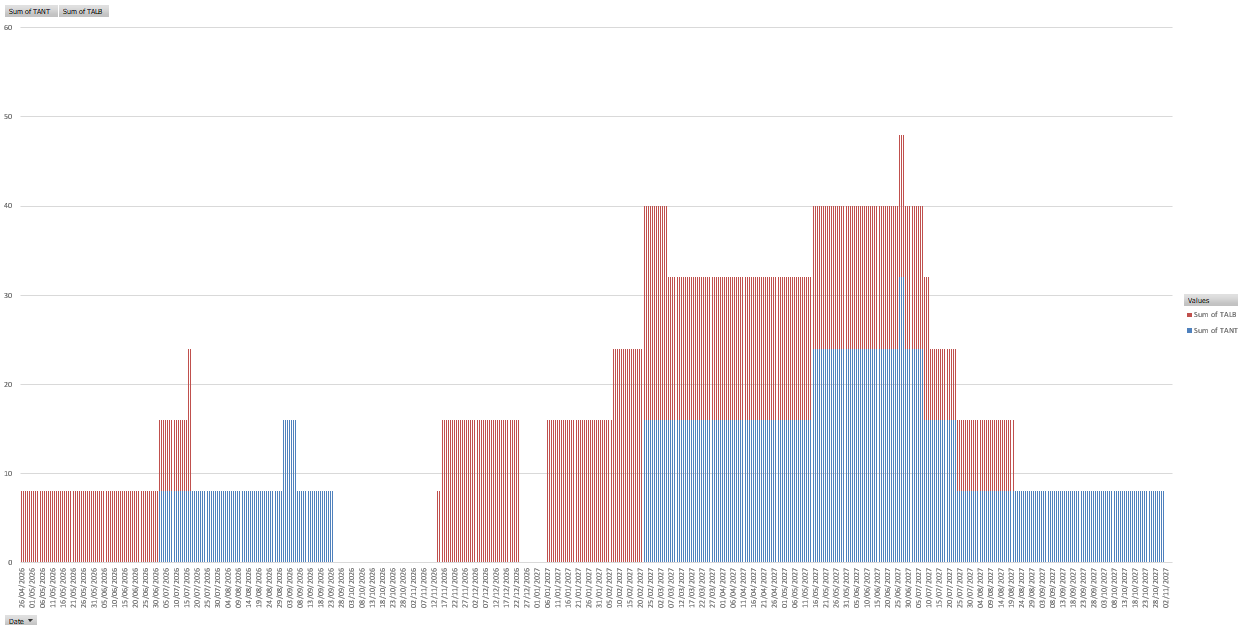
A “base case” histogram. Note the occassional spikes in personnel that can’t be accommodated in a FIFO arrangement
Step 5 – Smooth the Histogram (Critical Step)
Smoothing adjusts the histogram to fit the realities of FIFO rosters and infrastructure constraints.
Flatten daily fluctuations. Remote projects cannot ramp labour up and down daily because flights are scheduled weekly or fortnightly and camp beds are fixed. Adjust the histogram so headcount changes align with swing lengths.
Consider aircraft and camp limitations. Charter flights and camp accommodation have finite capacity; adding extra workers may require additional flights or new camp modules, significantly increasing cost.
Plan for roster inefficiencies. Because workers are rostered in fixed swings (e.g., 2 weeks on, 1 week off), they may remain on site when there is no productive work. This inefficiency should be reflected in the smoothed histogram.
Compare total hours. After smoothing, compare the total labour hours with the Step 2 estimate. The ratio reveals your productivity adjustment factor for remote conditions.
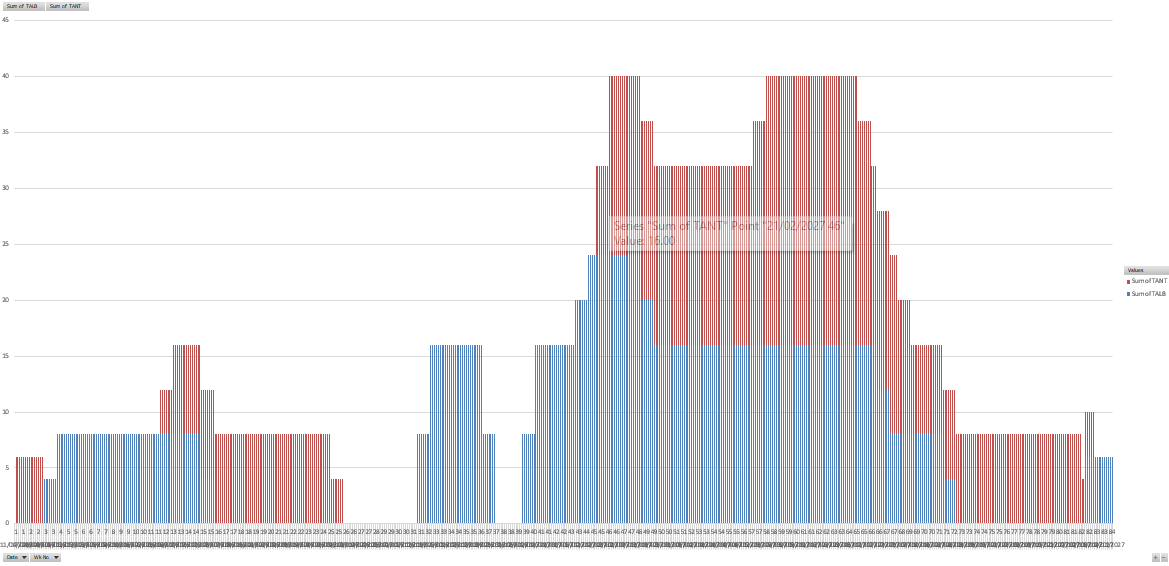
A “Smoothed” histogram. The labour peaks now last for an entire swing
Step 6 – Apply EBA Rates
Use the higher of the employer’s enterprise agreement (EBA) or the project EBA. Mining and energy projects often operate under project‑specific EBAs with higher rates and allowances. Include site allowances, travel allowances, redundancy provisions, daily remote area allowances and rostered days off (RDOs).
Account for uplift factors. Remote EBAs may include uplift percentages for overtime, night shift, public holidays and retention payments. Because EBAs vary by trade, summarise rates by classification and apply them to the smoothed labour hours.
Allow for cost consequences. The Energy Queensland agreement shows that site allowances must be confirmed and documented. Failing to account for allowances can result in underestimation and subsequent claims.
Step 7 – Detailed Prelims Build‑Up
Preliminaries should be built bottom‑up rather than applied as a percentage:
Site offices and facilities – costs for offices, meeting rooms, lunchrooms, ablutions and first‑aid rooms. Include freight to site, installation and demobilisation.
Cranes and major plant – daily hire charges plus mobilisation/demobilisation to remote locations. Consider retention of cranes during weather downtime.
Temporary power and utilities – diesel generators or connection to local micro‑grids, fuel supply, and maintenance.
IT and communications – satellite internet, radio networks and telephones. Effective data communications are critical for remote projects.
Travel and flights – charter or commercial flight costs for each swing, including contingencies for weather delays. Include bus transfers from airport to camp.
Camp costs – rental or depreciation of camp modules, catering, laundry, cleaning and waste management. Many contracts require a minimum number of rooms regardless of occupancy.
Supervision, HSE and medical – resident supervisors, safety officers, environmental specialists and on‑site medical personnel.
Logistics and freight – road transport of materials, spares and consumables. Remote isolation can require permanent logistics personnel to coordinate shipments.
Ensure each item is priced based on quantity (e.g., number of beds, number of flights) and unit rates from suppliers, rather than applying a global percentage.
Step 8 – Escalation, Risk, Overheads & Profit (OH&P)
Escalation – Remote labour markets are volatile. Wage growth in Western Australia and Queensland has been higher than national averages in recent years. Apply escalation for labour and materials over the project duration. Consider separate rates of escalation for materials and labour. Certain components (such as solar panels and batteries) may even de-escalate over the contract period.
Risk allowances – Include contingency for productivity risk, weather disruptions, industrial relations and equipment breakdowns. Remote projects often face extreme environments and logistic delays.
Company overhead and profit – Apply corporate overhead and margin to the estimated direct and prelim costs. In remote projects the margin should reflect higher risk and working capital requirements.
Commercial Risks of Getting It Wrong
Estimating FIFO contracts poorly can have severe consequences:
Margin erosion – Under‑estimating labour or prelims results in additional costs that may not be recoverable under fixed‑price contracts.
Labour blowouts – Failure to smooth labour swings leads to overmanning or overtime when crews cannot be demobilised. High wages and allowances quickly inflate costs.
Programme slippage – Inadequate logistics planning causes material delays and unproductive idle time. Slippage can trigger liquidated damages or extended camp costs.
Industrial disputes – Non‑compliance with EBAs or underpayment of allowances can lead to disputes, stoppages and reputational damage.
Cashflow distortion – Upfront costs for camps, plant mobilisation and flights must be funded before progress payments. Under‑estimating these cashflow requirements can strain working capital.
How Quantum Insights Advisory Can Assist
Quantum Insights Advisory (QIA) supports mining operators, renewable developers and contractors with commercially rigorous advice. We provide:
Detailed BOQ development – accurate material take‑offs and supplier engagement.
Labour modelling and productivity benchmarking – using historical data and our remote productivity database to derive realistic labour constants.
Programme‑linked cost planning – integrating scheduling and estimating so labour histograms align with project milestones.
Carbon and cost integration – assessing embodied carbon alongside capital costs for renewable projects.
Commercial risk identification – analysing EBA provisions, escalation, logistics risks and contingency requirements.
Tender strategy and negotiation support – preparing competitive but realistic tenders and negotiating contract terms that reflect remote project risks.
By combining quantitative analysis with local knowledge of remote construction, QIA helps clients avoid the pitfalls of percentage prelims and achieve successful project outcomes.
