Offshore Quantity Surveying Support: Risks, Benefits and Governance
Australian consultancies continue to face capacity constraints in construction and professional services. Outsourcing and offshore resourcing have expanded—driven by tight labour markets, cost pressure and remote‑work normalisation—with practices shifting repeatable technical tasks offshore to stabilise delivery and pricing. Industry analysis notes meaningful reductions in certain onshore roles as outsourcing grows, indicating a structural shift rather than a short‑term spike.
For quantity surveying (QS), offshore support can cover measurement, BOQs, cost‑plan inputs, benchmark maintenance and claims data preparation. The question is less whether to offshore and more how to govern it. Australia’s corporate regulators highlight governance gaps in offshore outsourcing—especially around data security, supervision and accountability—when critical functions are performed overseas. Robust QA and security frameworks are therefore prerequisites to maintain client confidence and service quality.
Market pressures in Australia
Skills shortages and rising local salary expectations have led many professional firms to consider offshore support models. Commentary around the regulator’s FY25 priorities shows outsourcing is increasingly common where recruitment rounds fail to attract suitable candidates and businesses seek resilience in the face of cyber and operational risks. In parallel, industry data points to an expanding outsourcing footprint in adjacent professional domains, reshaping workforce mix and delivery models.
Regulators observe that the use of offshore service providers (OSPs) has become material for many entities, with governance standards varying widely—an insight QS firms should heed as they formalise offshore arrangements.
Benefits of offshore delivery
Capacity and responsiveness: Offshore teams extend delivery windows and provide surge support for tenders and periodic estimate updates—mirroring benefits reported in other professional services.
Cost flexibility: Lower unit cost for repeatable tasks (e.g., measurement, benchmark updates) allows Australian teams to focus on higher‑value advisory and client engagement.
Process specialisation: Dedicated offshore hubs often build repeatable process expertise and template discipline—advantages seen in other sectors adopting structured offshore workflows.
Scalability: Ability to scale quickly for large BOQs or multiple bid packages under a common QA and coding standard.
Reality check: ASIC’s review shows these benefits are eroded when governance is weak—firms must retain the skills and frameworks to independently assess provider performance and manage risk.
QA frameworks
Accountability remains onshore. ASIC is explicit: outsourcing does not transfer fundamental obligations; firms must supervise and be able to independently evaluate offshore outputs. APRA’s CPS 231 similarly requires due diligence, Board‑approved outsourcing policy, ongoing monitoring and legally binding agreements for material activities—principles consultancies can adapt proportionately.
A practical QS QA stack
Task definition & templates: Scope, measurement rules, coding structure, and acceptance criteria embedded in workbooks. (Supervision and documentation expectations align with ASX Clear guidance on offshoring).
Layered checking: Self‑check → peer review (offshore) → independent onshore sign‑off for deliverables that affect client advice. (Onshore retains competence to identify material risks).
SLA & performance: Defined KPIs (turnaround, defect rate, rework time), audit cycles, right‑to‑review and termination clauses. (ASX Clear guidance for service levels and supervision).
Continuous improvement: Error logs, template updates and lessons‑learned cycles feeding back into scopes and training.
Data security
Cyber.gov.au warns that offshore services introduce jurisdictional, privacy and security risks, including potential foreign lawful access to data or covert collection; organisations should adopt supplier due‑diligence and shared‑responsibility models with clear delineation of roles. ASIC likewise flags cyber exposure, operational disruption and conflicts with foreign laws if offshore functions are not adequately supervised.
Minimum controls for QS artefacts (drawings, cost data, tenders):
Role‑based access, device controls and activity logging in a secure environment.
Data classification, least‑privilege principles, and time‑bound links for document release.
Incident response runbook and breach notification aligned with Australian expectations.
Supplier transparency: evidence of the provider’s security posture and patching regime.
Case example
Scenario: A consultancy must deliver a first‑pass cost plan and a long‑list BOQ for a major social‑infrastructure project in four weeks.
Workflow (offshore ↔ onshore):
Onshore scoping: Lead QS defines packages, measurement hierarchy and QA criteria; criticality assessed (aligns with “materiality” thinking in outsourcing guidance).
Secure release: Drawings and standards uploaded to a controlled environment with role‑based permissions; responsibilities formalised per shared‑responsibility model.
Offshore measurement: Offshore team performs take‑offs and populates structured workbooks; offshore peer review conducted. (Client confidentiality controls remain in force).
Onshore QA & rates: Onshore QS independently verifies quantities, builds rates and integrates benchmarks; retains accountability consistent with ASIC’s position on outsourcing.
Consolidation & sign‑off: Master estimate prepared with risk allowances; performance data (defects, cycle time) logged for continuous improvement and SLA review (ASX Clear supervision expectations).
Result: Turnaround improved without diluting governance; repeatable tasks performed offshore, commercial judgement and client advice retained onshore.
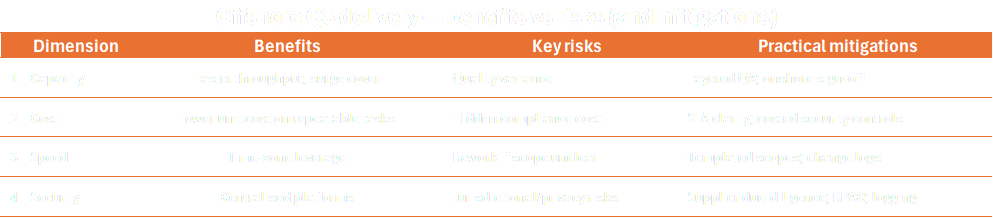
Sources: ASIC offshore outsourcing review; Cyber.gov.au procurement & outsourcing guidelines.
Practical Takeaways
Treat offshore QS as a material outsourcing decision; maintain onshore accountability and the skills to test outputs.
Implement SLA‑backed QA (templates, checks, defect logs, audits), consistent with APRA/ASX expectations.
Use secure, auditable platforms and a clear shared‑responsibility model for data handling.
Pilot with a targeted scope to tune templates, cadence and supervision before scaling.
How QIA Can Assist
QIA practices what we preach. Our integrated onshore–offshore model delivers clients lower consultancy costs while maintaining high-quality QS and Commercial services.
References
ASIC — Review identifies governance gaps in offshore outsourcing; accountability remains onshore. [consultanz.com.au]
Outsource Accelerator — Summary of ASIC concerns on offshore governance risks. [australian...nce.com.au]
Cyber.gov.au — Guidelines for procurement and outsourcing (supplier security, jurisdictional risks, shared‑responsibility). [data.gov.au]
APRA — CPS 231 Outsourcing (policy, due diligence, monitoring, offshore notifications). [mbansw.asn.au]
ASX Clear — Guidance Note 9: Offshoring & Outsourcing (SLAs, supervision, notifications). [industry.gov.au]
Professional Planner — Outsourcing trends and skills‑shortage context. [quarrymagazine.com]
Adviser Ratings — Workforce shifts linked to outsourcing. [anao.gov.au]